Information Density

Many people write autobiographies.
But the details of a life are rarely transferable.
Different backgrounds.
Different eras.
Different opportunities.
Reading someone else’s life story does not necessarily teach you how to live your own.
From the perspective of information theory, the problem becomes clearer.
Autobiographies often have low information density.
They contain a large amount of narrative, context, and personal details —
but only a small amount of transferable insight.
The signal is buried inside too much noise.
To extract the useful principles,
a reader often has to read the same autobiography many times.
Only then can they slowly infer
how the author thinks,
how they interpret events,
and how they make decisions.
Most readers never reach that stage.
They read the story once,
feel inspired for a moment,
and then eventually forget it.
The signal-to-noise ratio is simply too low.
Philosophy works differently.
Instead of asking readers to extract the principles themselves,
philosophy presents the distilled signal directly.
It focuses not on the story,
but on the way of seeing behind the story.
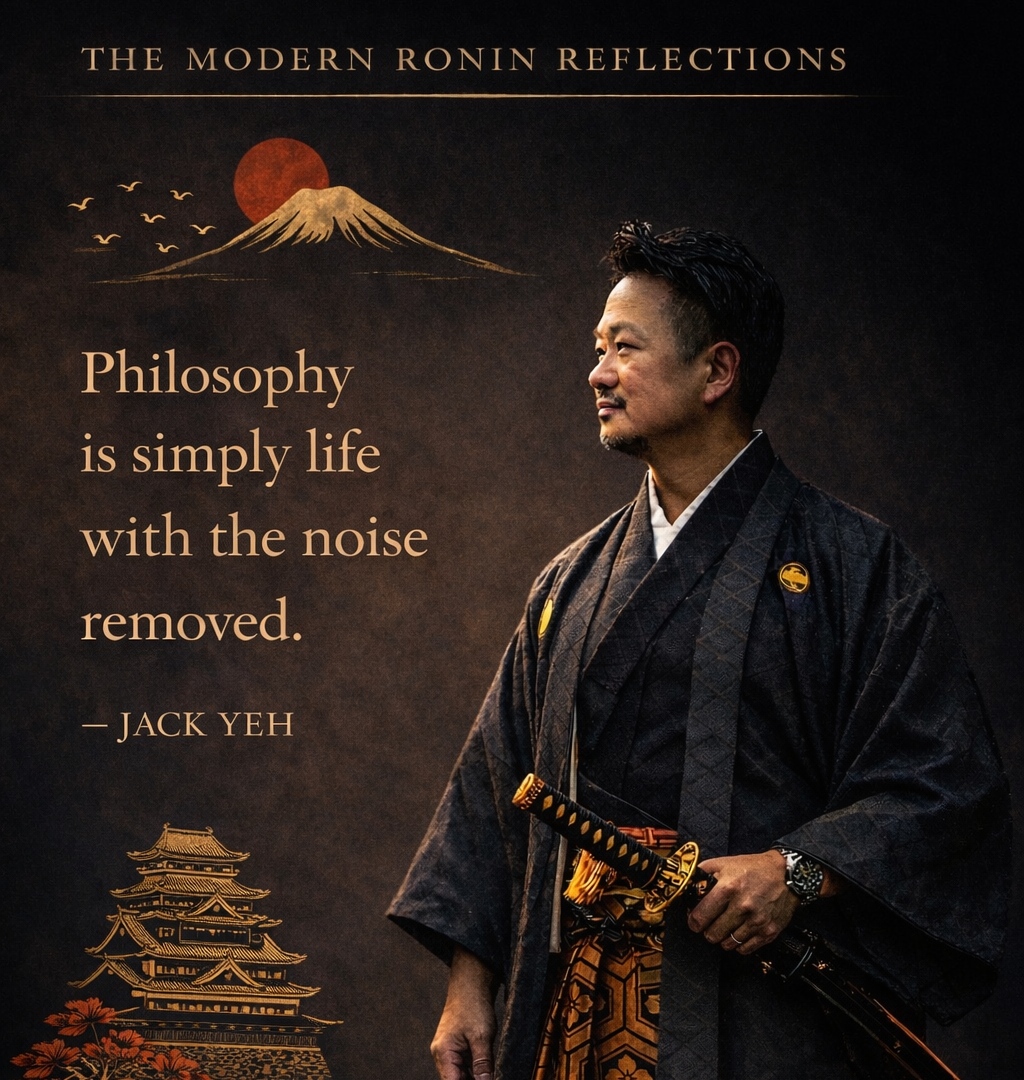
In that sense, philosophy is simply the high-density form of experience.
It removes the noise
and preserves the signal.
A principle.
A perspective.
A way of understanding the world.
Once you see clearly,
that same perspective can be applied again and again —
across different problems,
different situations,
and an entire lifetime.
很多人寫自傳。
但人生的細節其實很難被複製。
不同的背景。
不同的時代。
不同的機會。
閱讀別人的人生故事,
並不代表你就學會了如何過自己的人生。
如果從資訊理論的角度來看,
問題就會變得非常清楚。
自傳通常具有很低的信息密度。
它包含大量敘事、背景與個人細節,
但真正具有通用價值的洞見卻很少。
真正的訊號,
被大量的雜訊掩蓋。
如果讀者想要提煉出有用的原則,
往往需要把同一本自傳讀很多遍。
慢慢地,他才可能推斷出:
作者是怎麼思考的,
如何理解事件,
又如何做出決策。
但大多數讀者很少走到那一步。
他們讀完一次故事,
短暫地受到鼓舞,
然後很快就遺忘。
因為訊號與雜訊的比例實在太低。
哲學的方式則不同。
哲學不是讓讀者自己去提煉原則,
而是直接呈現經驗提煉之後的訊號。
它關注的不是故事本身,
而是故事背後的看世界的方法。
從某種意義上來說,
哲學其實就是高信息密度的人生經驗。
它去除了雜訊,
保留下真正的訊號。
一個原則。
一種視角。
一種理解世界的方法。
當你真正看清楚之後,
同樣的視角就可以被反覆使用。
在不同問題中,
在不同情境中,
甚至貫穿整個人生。