A Ronin Bows Only to Truth
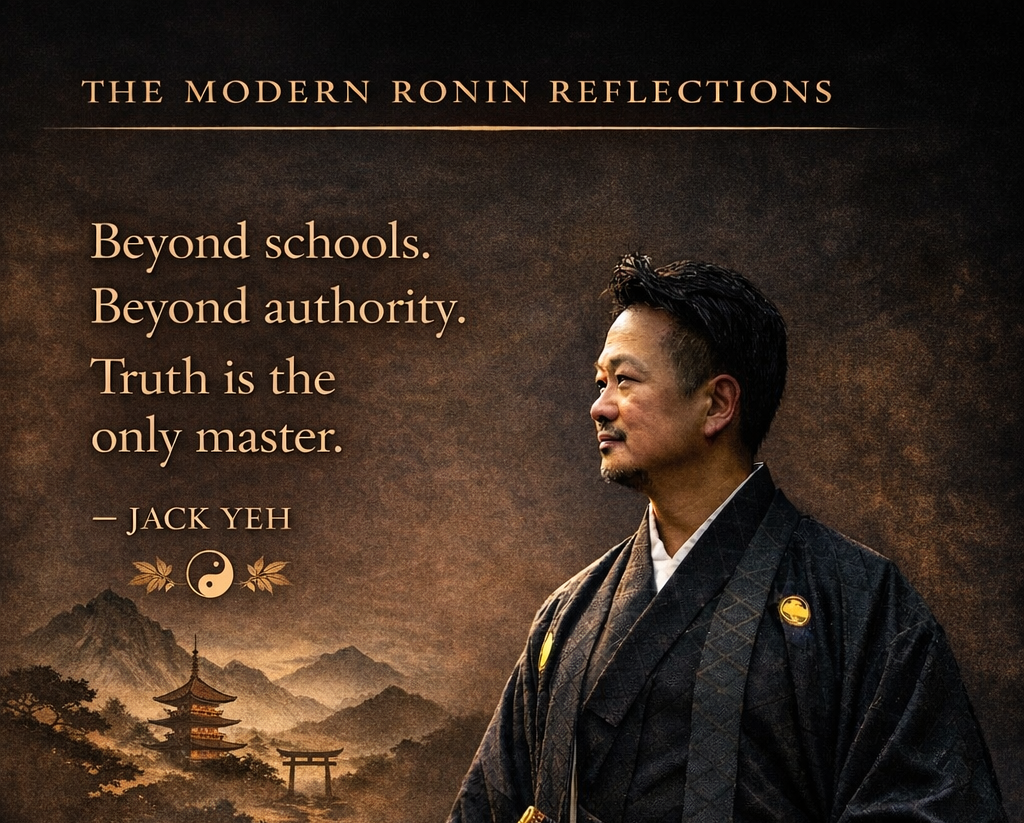
Reading the writings of Miyamoto Musashi in The Book of Five Rings, I encountered a passage that felt strikingly familiar.
Musashi warned that when people rely too heavily on a teacher, they may eventually rely on authority itself. Over time, the authority of the teacher quietly becomes their own borrowed authority. Those whose will is not firm can easily fall into rigid dogma and imitation.
This idea resonates strongly with my own experience.
Throughout my life, I have never believed in authority for its own sake. The only authority worth respecting is truth. In science and in human progress, every generation must be able to question the previous one. If we simply inherit authority without questioning it, knowledge does not grow—it shrinks, like a Russian nesting doll where each layer becomes smaller than the last.
Over the years, I have also observed something common across many cultures in East Asia—whether in China, Japan, or even Taiwan. There is often a strong emphasis on lineage and “schools.” People frequently ask questions such as: Who was your teacher? Which school do you belong to? Academic circles sometimes ask, Which professor trained you?
While lineage can preserve tradition, it can also create invisible boundaries. When knowledge becomes defined by factions or schools, people may begin defending their lineage instead of seeking truth.
Interestingly, this perspective also echoes the teachings of Gautama Buddha. In the spirit of the Kalama Sutta, the Buddha advised people not to believe something simply because it was taught by tradition, scripture, or even by himself. Instead, he encouraged people to test the teachings through their own experience and see whether they truly reduce suffering.
Truth, in other words, must be discovered—not inherited.
Perhaps this is why I have always felt uncomfortable with hierarchical “master–disciple” relationships. Even after starting my own educational platform, when people call me “teacher” or ask to become my disciple, I often tell them that we are simply travelers on the same path. We may have different areas of expertise, but we can learn from one another.
Knowledge should not create dependency; it should create independence.
Looking back, I find it fascinating that Musashi’s spirit of self-realization, the Buddha’s emphasis on direct experience, and my own instinct to seek truth rather than authority all converge on the same principle:
We should bow not to people, nor to institutions,
but to truth itself.
閱讀 Miyamoto Musashi 的《The Book of Five Rings》時,有一段話讓我非常震撼。
武藏提到,如果一個人過度依賴老師,往往也會依賴權威。久而久之,老師的權威就會變成自己借來的權威。而內心不夠堅定的人,很容易落入僵化的門派與模仿之中。
這段話與我一直以來的想法產生了很深的共鳴。
在人生的很多經驗裡,我從來不相信權威本身。我相信的只有一件事——真理。在人類的歷史與科學的發展中,每一代人都必須能夠質疑上一代。如果盲目崇拜權威,知識不會成長,反而會像俄羅斯套娃一樣,一層比一層更小。
多年來我也觀察到一個現象:在東亞文化裡,無論是在中國、日本,甚至台灣,常常存在一種很強的「門派」觀念。人們很習慣問:「你的老師是誰?」、「你是哪一個流派的?」在學術界甚至也常常會問:「你是哪個教授帶出來的?」
傳承本身並不是問題,但當知識被門派化之後,人們有時候會開始捍衛自己的門派,而不是追求真理。這種無形的界線,往往會讓思想逐漸變得僵化。
有趣的是,這種思考其實也與 Gautama Buddha 的教導相通。在《Kalama Sutta》的精神中,佛陀曾經告訴人們:不要因為傳統、經典、老師,甚至不要因為是佛陀自己說的,就立刻相信。應該透過自己的實踐與體驗,看看這些方法是否真的能減少痛苦。
換句話說,真理必須被發現,而不是被繼承。
也許正因如此,我一直對「師父與徒弟」這種上下階層的關係感到不太自在。當我開始做自媒體與教學平台後,常有人叫我「葉老師」,甚至希望成為我的徒弟。但我常常告訴他們,我們其實只是走在同一條道路上的人。我們各自有專長,但彼此分享、彼此學習。
知識不應該讓人依附,
而應該讓人更獨立。
回頭看來,我發現一件很有意思的事情:
宮本武藏強調自悟的精神,
佛陀強調親身驗證的智慧,
而我自己一直以來的直覺,
其實都指向同一件事:
我們不應向任何人或任何組織低頭,
我們只需要向真理低頭。