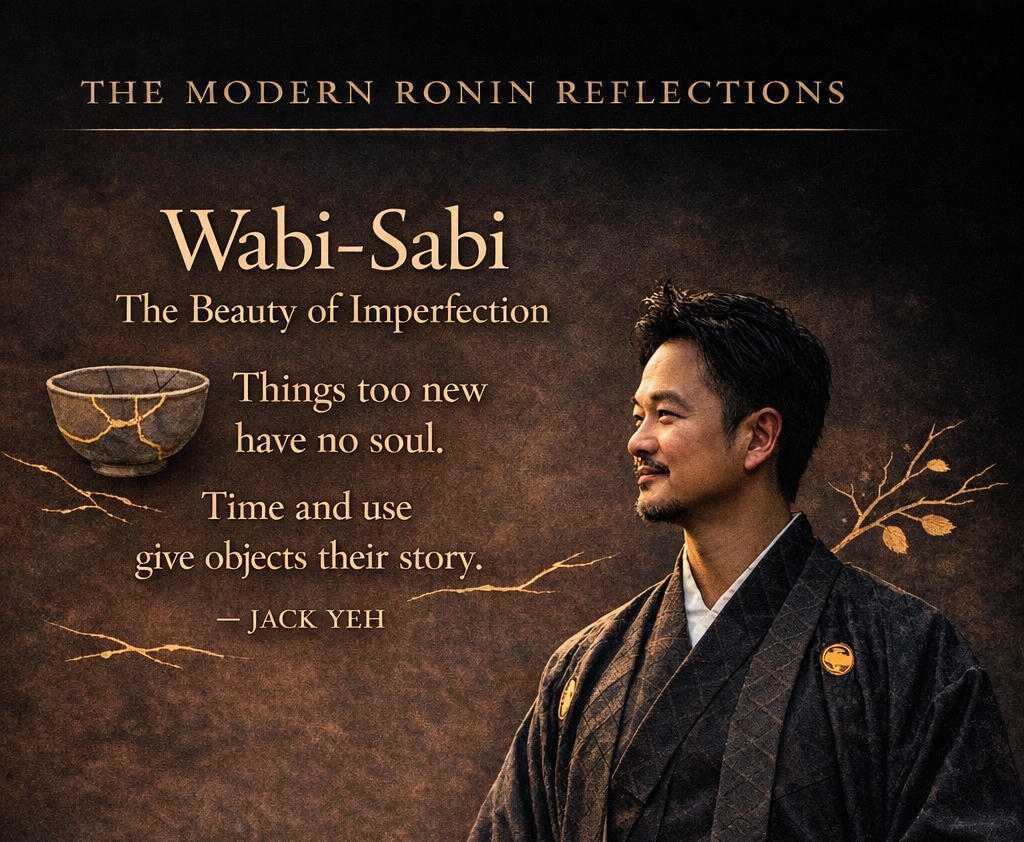
Wabi-Sabi — The Beauty of Imperfection

I have always believed in one simple idea:
Things that are too new often have no soul.
I rarely try to keep my belongings in perfect condition.
I don’t wrap my car, put protective film on my watch, or try to keep my bags and jackets looking brand new.
Because objects are meant to be used, not preserved.
When something stays with you for many years,
the scratches, creases, and marks left by time gradually become part of your own story.
They are not flaws — they are a form of beauty.
Later I discovered that the Japanese have a philosophy that expresses this idea beautifully:
Wabi-Sabi.
It is an aesthetic that appreciates the beauty of imperfection, simplicity, and the passage of time.
A well-known example is Kintsugi, the Japanese art of repairing broken pottery with lacquer mixed with gold.
Instead of hiding the cracks, the repair highlights them.
The fractures become part of the object’s history rather than something to be concealed.
When I learned this, I was genuinely surprised.
Because I realized that this had always been the way I lived.
Objects are meant to be used.
And the marks left by time are what give them their soul.
我一直相信一件事:
太新的東西,其實沒有靈魂。
我很少為了「保持完美」去保護物品。
車子不包膜,手錶不貼膜,包包和外套也不刻意維持全新。
因為東西本來就是拿來使用的,而不是拿來供奉的。
當一個物件陪伴你很多年,
那些刮痕、摺痕與歲月留下的痕跡,
其實都成為了只屬於你自己的印記。
這不是瑕疵,而是一種美。
後來我才知道,日本有一種美學叫做 侘寂(Wabi-Sabi)。
它所欣賞的,正是時間與不完美所帶來的自然之美。
例如日本有一種修補陶器的技藝叫做 金繕(Kintsugi)。
當茶碗破裂時,人們不會丟掉它,而是用金漆把裂縫修補起來。
那些裂痕不再被視為缺陷,而是成為這個器物獨一無二的歷史。
我很驚訝地發現,
這其實一直就是我的生活態度。
東西是拿來用的。
而使用之後留下的痕跡,
正是它的靈魂。