Escaping Yourself Is Consumerism’s Greatest Business Model
The legendary Japanese tea master Sen no Rikyū is often associated with a profound idea:
“Excessive possessions are a form of violence against our awareness.”
The more I reflect on it, the more meaningful it becomes.
Every object we own demands a portion of our attention. We have to organize it, maintain it, clean it, store it, and simply remembering that it exists consumes cognitive resources.
The real issue is not the objects themselves.
The deeper question is:
Why do we keep buying things we don’t truly need?
In many cases, the answer is not necessity.
It is the desire to escape ourselves.
When people struggle to face loneliness, anxiety, or uncertainty, consumption becomes a temporary refuge. We are not merely buying products—we are buying an imagined version of ourselves.
A new jacket.
A luxury watch.
A new car.
A symbol of status.
Each purchase quietly whispers,
“Perhaps this is who I could become.”
But that satisfaction rarely lasts.
So the cycle continues.
We buy more, own more, maintain more, and gradually burden our minds with countless unnecessary possessions.
This is why I believe Japanese minimalism carries a deeper philosophy than simply owning less.
Many Western interpretations of minimalism emphasize creating more space for efficiency.
Japanese minimalism values emptiness itself.
Space is not something waiting to be filled.
Space is part of the beauty.
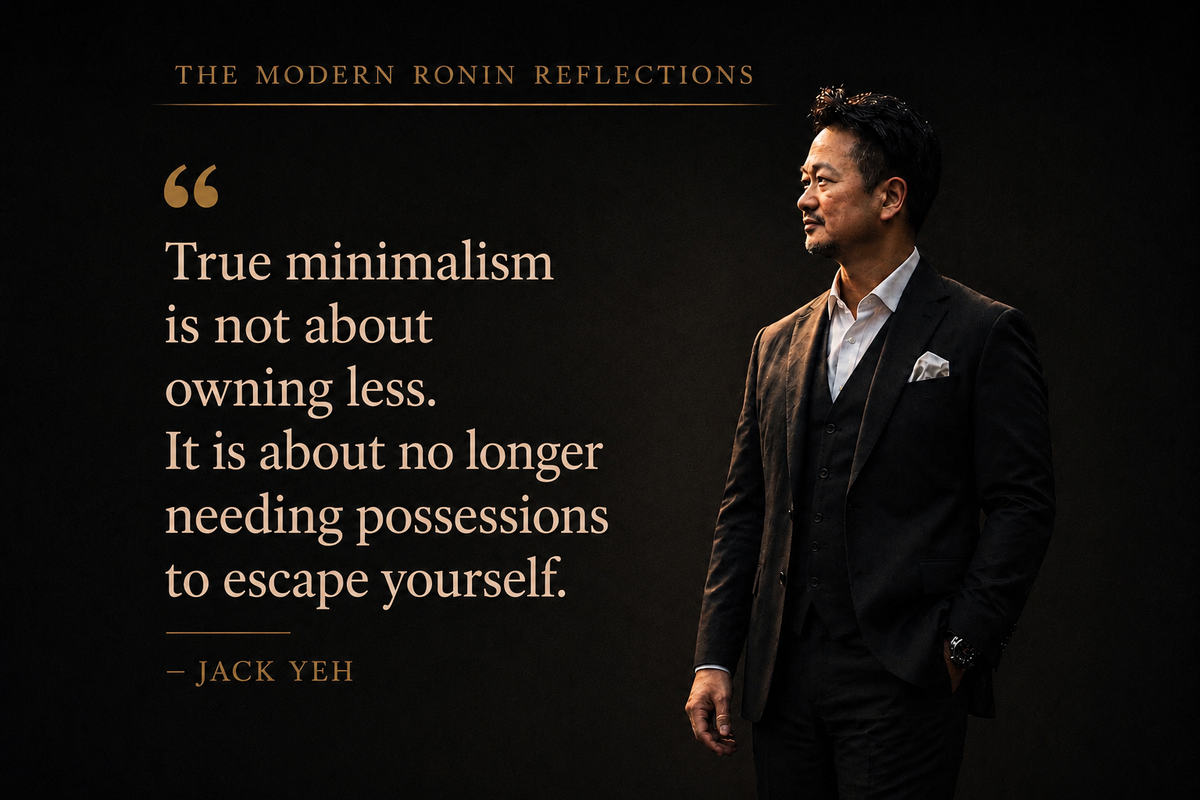
True freedom is not found in owning more.
It begins the moment we stop using possessions to escape ourselves.
Only then do we realize that we have always needed far less than we imagined.
逃避自我,是消費主義最大的商機
日本傳奇茶人千利休曾說過一句耐人尋味的話:
「多餘的物品,是對認知的一種暴力。」
我越來越能理解這句話。
每一件你擁有的物品,都會佔據你的注意力。你需要整理它、維護它、清潔它、收納它,甚至只是知道它存在,就已經消耗了你的認知資源。
真正的問題並不是物品本身。
而是我們為什麼會一直購買那些其實並不需要的東西?
我認為,答案往往不是「需要」,而是逃避自我。
當一個人無法面對自己的空虛、焦慮或迷惘時,購物便成了一種短暫的慰藉。我們不是在購買一件商品,而是在購買一個想像中的自己。
新的衣服、新的手錶、新的車子、新的身分象徵,彷彿都在告訴自己:
「只要擁有它,我就會變成另一個人。」
然而,這種快樂通常十分短暫。
於是,人開始不斷購買,不斷累積,也不斷增加自己的心理負擔。
我也因此開始理解,日本極簡主義與西方極簡主義最大的不同。
許多西方的極簡主義,更像是在整理空間,好讓生活更有效率。
而日本美學中的極簡,真正珍惜的是留白。
空間本身,就是美的一部分。
留白不是等待被填滿,而是值得被保留。
真正的自由,不是擁有更多。
而是當你停止透過物品逃避自己之後,你終於發現:
原來,我真正需要的東西,一直都很少。