Strength and Wisdom Should Never Be Opposites
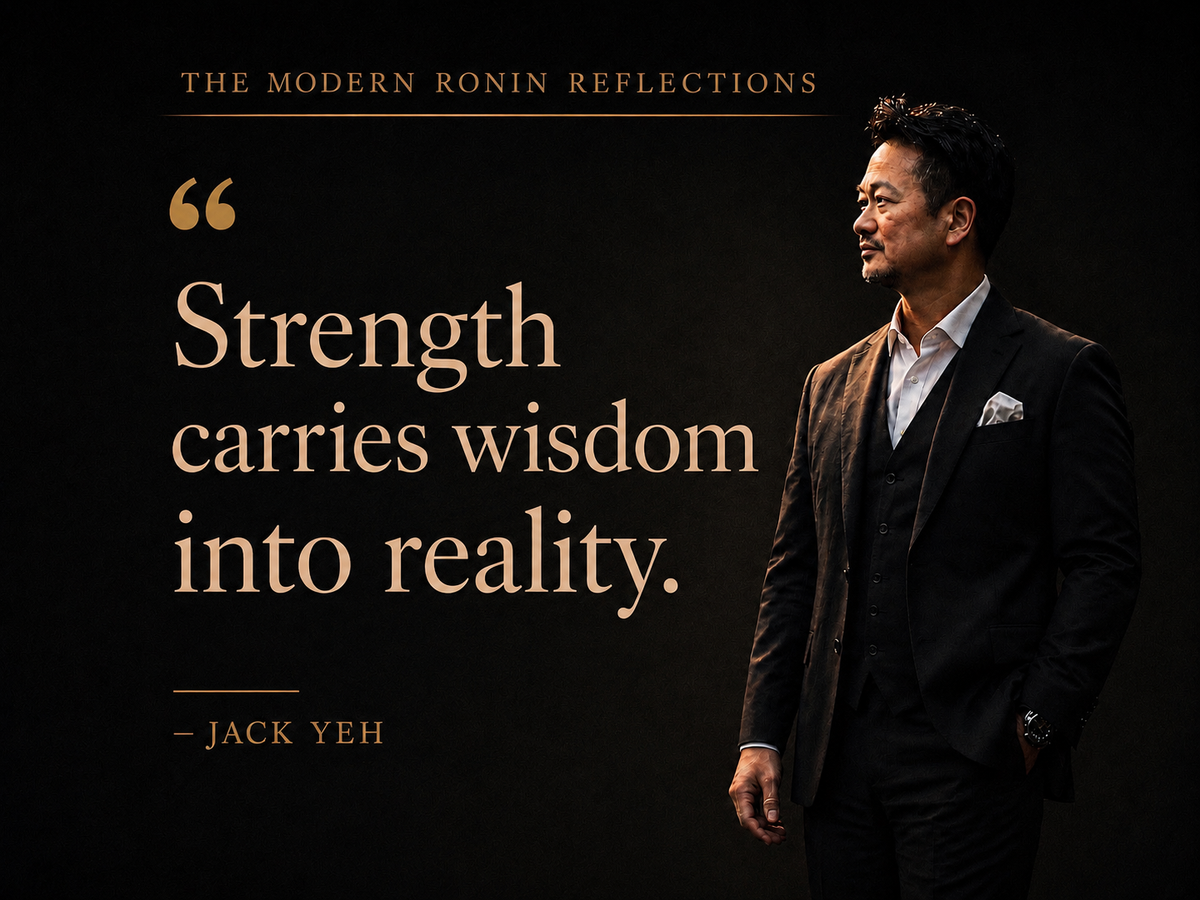
I have never believed that strength and wisdom should be treated as opposites.
At some point, modern culture seems to have developed a strange stereotype: if someone goes to the gym and builds muscle, people assume that he must be all brawn and no brains. On the other hand, if someone reads, researches, becomes a scholar, engineer, or intellectual worker, it somehow seems acceptable for him to neglect his body entirely.
I have always found this division strange.
Why should strength and wisdom be mutually exclusive?
I believe a man should cultivate both the inner and the outer self.
He should train his body while sharpening his mind. He should have strength, but also judgment. He should be capable of action, but also capable of reflection.
I often see intellectual workers—engineers, researchers, and professors—devoting enormous amounts of time to knowledge, research, and their careers while paying very little attention to their physical condition.
Some become physically weak and lack endurance. Others spend so much of their lives sitting and working that they gradually lose control of their physical health.
This is not a criticism of any particular body type.
It simply raises a deeper question for me:
Why are we willing to manage our knowledge, education, and careers so carefully, while sometimes neglecting the very body that carries all of those abilities?
I have always believed that a strong, healthy, and well-trained body is one of the most important vessels for wisdom.
We often imagine wisdom as something that exists only in the mind.
But everything we read, think, create, build, explore, and put into practice ultimately has to pass through the body before it can enter the real world.
Your mind may contain extraordinary ideas and profound insights, but you still need a capable body—with strength, endurance, and the ability to act—to carry those ideas into reality.
The body is the vessel through which wisdom enters the real world.
If that vessel loses its health, strength, and endurance, even the deepest wisdom and greatest knowledge become limited in what they are able to accomplish.
That is why, to me, physical training has never been merely about appearance or building muscle.
More importantly, it is about building a strong enough vessel to carry your thoughts, your wisdom, and the life you want to create.
Strength carries wisdom into reality.
Historically, strength and wisdom were not always treated as separate ideals.
Traditional Japanese warriors were not expected to master combat alone.
A cultivated samurai might also study strategy, philosophy, calligraphy, poetry, painting, and the arts.
This is the ideal I deeply appreciate: the dual cultivation of the literary and the martial—bunbu ryōdō.
Miyamoto Musashi is a powerful example.
He was not merely a swordsman. He was also a thinker of strategy, the author of The Book of Five Rings, and a practitioner of painting and other arts.
His strength was not merely physical.
His wisdom was not merely intellectual.
Both were part of the same lifelong cultivation.
Ancient Greece held a similar ideal.
Philosophers were not necessarily imagined as people who simply sat indoors and thought.
Socrates served as a soldier, and ancient Greek education placed importance on the cultivation of both the body and the mind.
The human being was understood as a whole.
Body and mind were never meant to be separated.
That is why I reject the idea that we must choose between strength and wisdom.
A complete person is not someone who only possesses a strong body, nor someone who only possesses an intelligent mind.
To me, true strength means:
A strong body, a discerning mind, and an ordered inner world.
Real cultivation means training all three.
You read and think.
You train and act.
You experience and reflect.
And you continuously correct yourself.
Strength is not the enemy of wisdom.
Wisdom is not the opposite of strength.
A mature person should bring strength and wisdom back together within himself.
力量與智慧,不該二選一
我一直不認為,力量與智慧應該是非此即彼的。
不知道從什麼時候開始,這個時代似乎形成了一種很奇怪的刻板印象:一個人如果上健身房、鍛鍊肌肉,就好像代表他頭腦簡單、四肢發達;而一個人如果讀書、做研究,成為學者、工程師或腦力工作者,就彷彿理所當然地應該瘦弱、缺乏體能,甚至完全忽略自己的身體。
我一直覺得這種二分法非常奇怪。
為什麼力量與智慧不能存在於同一個人身上?
我認為,一個男人應該內外兼修。
你既要鍛鍊自己的身體,也要磨練自己的頭腦;既要有力量,也要有判斷力;既要能夠行動,也要能夠思考。
我常常看到一些腦力工作者,包括工程師、研究人員、教授,把大量的時間投入知識、研究與職涯,卻長期忽略自己的身體。有些人非常瘦弱、缺乏體能,有些人則因為長期久坐與缺乏管理而失去了良好的身體狀態。
這並不是對任何一種體型的否定。
它真正讓我產生的疑問是:
為什麼我們可以如此認真地管理自己的知識、學歷與職涯,卻不一定同樣認真地管理承載這些能力的身體?
因為我一直認為,一個健康、強健而且經過鍛鍊的身體,本身就是智慧最重要的載體之一。
我們很容易把智慧想像成只存在於大腦裡。
但事實上,你所有的閱讀、思考、創造、工作、探索與實踐,最終都必須透過你的身體才能進入現實世界。
你的腦中可以有再深刻的思想、再精彩的構想,但你仍然需要一個具有力量、耐力與行動能力的身體,把這些思想帶到現實之中。
身體,是智慧在現實世界中的載體。
如果這個載體失去了健康、力量與耐力,那麼再深刻的智慧、再豐富的知識,也會受到限制。
所以對我而言,鍛鍊身體從來不只是為了外表,也不只是為了擁有更多肌肉。
更重要的是,你是在打造一個足夠強大的載體,去承載你的思想、你的智慧,以及你想要完成的人生。
Strength carries wisdom into reality.
力量,讓智慧進入現實。
從歷史來看,力量與智慧其實也從來不必然是分離的。
傳統日本武士所追求的並不只有武術。
一個成熟的武士除了劍術與兵法之外,也可能學習哲學、書法、詩歌、繪畫與藝術。
這就是我很欣賞的文武兩道。
宮本武藏就是一個很好的例子。
他不只是一位劍客,也是一位兵法思想家。他留下《五輪書》,同時也從事書畫與藝術創作。
他的力量不只是劍術。
他的智慧也不只是書本知識。
兩者共同構成了他整個人的修行。
古希臘也曾經存在類似的理想。
哲學家並不一定被想像成只能坐在書房裡思考的人。
蘇格拉底曾經參與戰爭,而古希臘的教育本身也同時重視身體與心智的鍛鍊。
對他們而言,人是一個完整的存在。
身體與心智,本來就不應該被切割。
所以我始終不接受「力量」與「智慧」只能選擇其中一邊。
真正完整的人,不是只有強壯的身體,也不是只有聰明的頭腦。
對我而言,真正的力量是:
身體有力量,頭腦有判斷,內心有秩序。
真正的修行,就是同時鍛鍊這三件事情。
你閱讀,你思考。
你訓練,你行動。
你經歷,你反思。
然後不斷修正自己。
力量不是智慧的敵人。
智慧也不是力量的反面。
真正成熟的人,應該讓力量與智慧重新在自己身上合而為一。