Better Whole Than Good : Reflections on The Twilight Samurai
The Twilight Samurai is a deeply moving film.
The character of Iguchi Seibei, portrayed by Hiroyuki Sanada, left a strong impression on me. He is an exceptionally skilled swordsman, yet remarkably humble. He does not seek status or recognition, and he endures ridicule, disrespect, and misunderstanding with extraordinary patience.
To many viewers, he represents an ideal human being.
Yet that is precisely what made me pause.
Seibei feels more like an ideal personality than a real one.
Perhaps he represents director Yoji Yamada's vision of the ideal samurai, or even the Confucian archetype of the "gentleman" — the virtuous person one ought to become. The problem is that such a person rarely exists in reality.
In real life, people of great ability usually possess pride, ambition, anger, desires, and sharp edges. It is difficult to imagine someone with extraordinary talent who can endure constant disrespect and humiliation without resentment.
This is perhaps my only reservation about the film.
It is beautiful.
But it is also highly idealized.
And that reminds me of a famous idea often associated with Carl Jung:
"I would rather be whole than good."
To me, this insight reveals something fundamental about human nature.
Whenever we carry an ideal image of who we should be — whether it is the Confucian gentleman, the saint, or the perfect person — we inevitably begin to suppress the parts of ourselves that do not fit that image.
Anger.
Jealousy.
Fear.
Desire.
Self-interest.
These aspects do not disappear simply because we deny them.
Jung called them the Shadow.
The moment we attempt to become perfect, the Shadow is born.
Therefore, true growth is not about becoming a flawless person. It is about recognizing our darker aspects, understanding them, and ultimately integrating them into a complete personality.
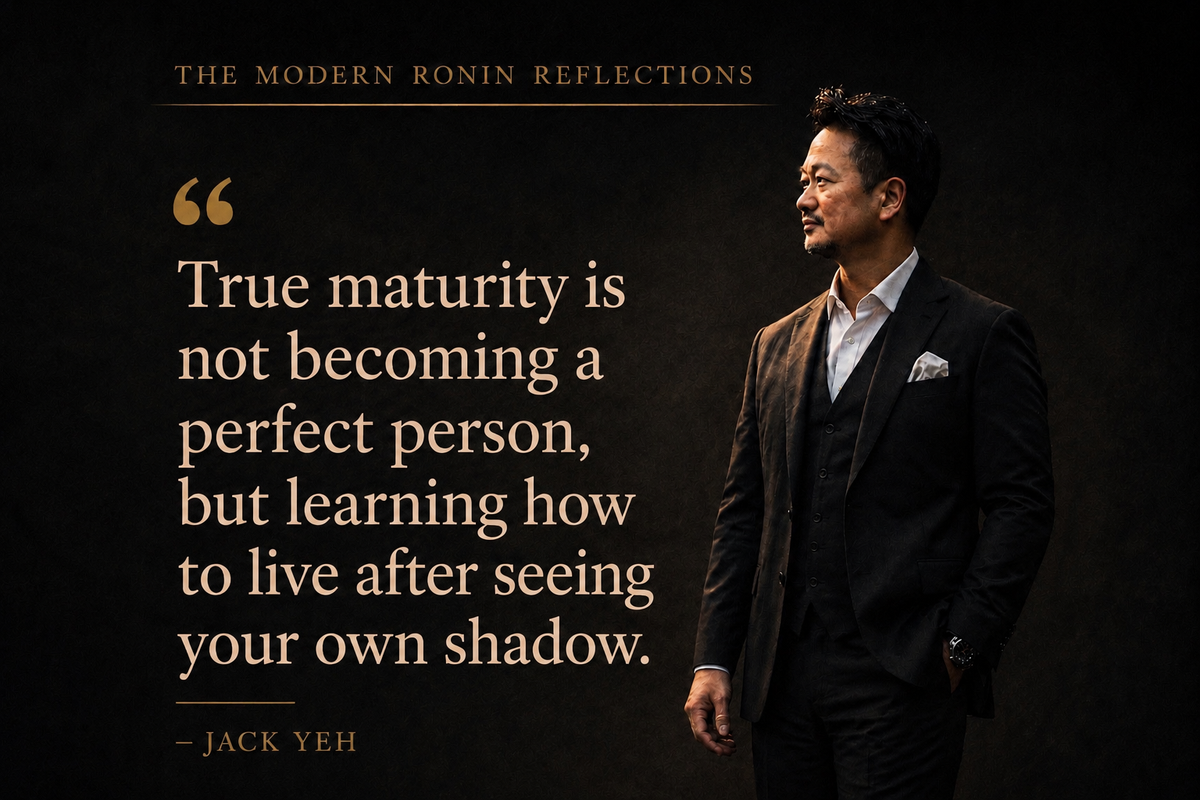
A mature person is not someone without darkness.
A mature person is someone who sees that darkness clearly and consciously chooses how to live.
That is why I believe:
Rather than striving to become a good person, we should strive to become a whole person.
Because authenticity has far more power than perfection.
And in the end, reality always has the final say.
Theory must survive reality.
與其做一個好人,不如做一個完整的人——《黃昏清兵衛》觀後感
《黃昏清兵衛》是一部令人印象深刻的電影。
真田廣之飾演的井口清兵衛,是一位劍術高超卻極度謙遜的武士。他不爭名、不爭利,甚至能夠忍受同僚的輕視與嘲笑。在許多人眼中,他是一位近乎完美的人物。
然而,正因為如此,我反而產生了一個有趣的想法。
清兵衛更像是一種理想人格,而不是真實人格。
他或許代表著導演山田洋次心目中的理想武士,也像是儒家文化中所推崇的「君子」原型。問題在於,這樣的人在現實世界中幾乎不存在。
在真實的人性裡,一個能力極強的人,往往也會有自己的驕傲、憤怒、慾望與稜角。我們很少看到一個擁有巨大能力的人,卻能夠長期忍受輕視、羞辱與誤解,而始終保持如此平靜。
這也是我對這部電影最大的感受:它很美,但它更像是一種理想。
而這讓我想起榮格的一句話:
「與其做一個好人,我寧願做一個完整的人。」
在我看來,這句話揭示了一個重要的人性真相。
當一個人的心中存在著某種理想形象——無論是君子、聖人,還是完美的人——他就會不斷要求自己去符合那個形象。
於是,那些與理想不符的部分:
憤怒、
嫉妒、
慾望、
恐懼、
自私,
便會被壓抑進潛意識之中。
這些被壓抑的部分並不會消失。
榮格稱之為「陰影」。
只要一個人試圖成為完美的人,陰影便不可避免地形成。
因此,我認為真正的成長並不是成為一個完美的人,而是學會認識自己的陰影、理解自己的陰影,並最終整合自己的陰影。
真正成熟的人,不是沒有黑暗面的人。
而是知道自己擁有黑暗面,卻依然能夠有意識地選擇如何活著的人。
這也是為什麼我始終認為:
與其追求成為一個好人,不如努力成為一個完整的人。
因為真實,永遠比完美更有力量。