German Craftsmanship and Japanese Craftsmanship: Two Different Souls

Today, my wife asked me an interesting question.
She asked:
Germany and Japan are both world-class nations known for craftsmanship, engineering, and quality.
So why do they feel so different?
I thought about it for quite a while.
And I realized:
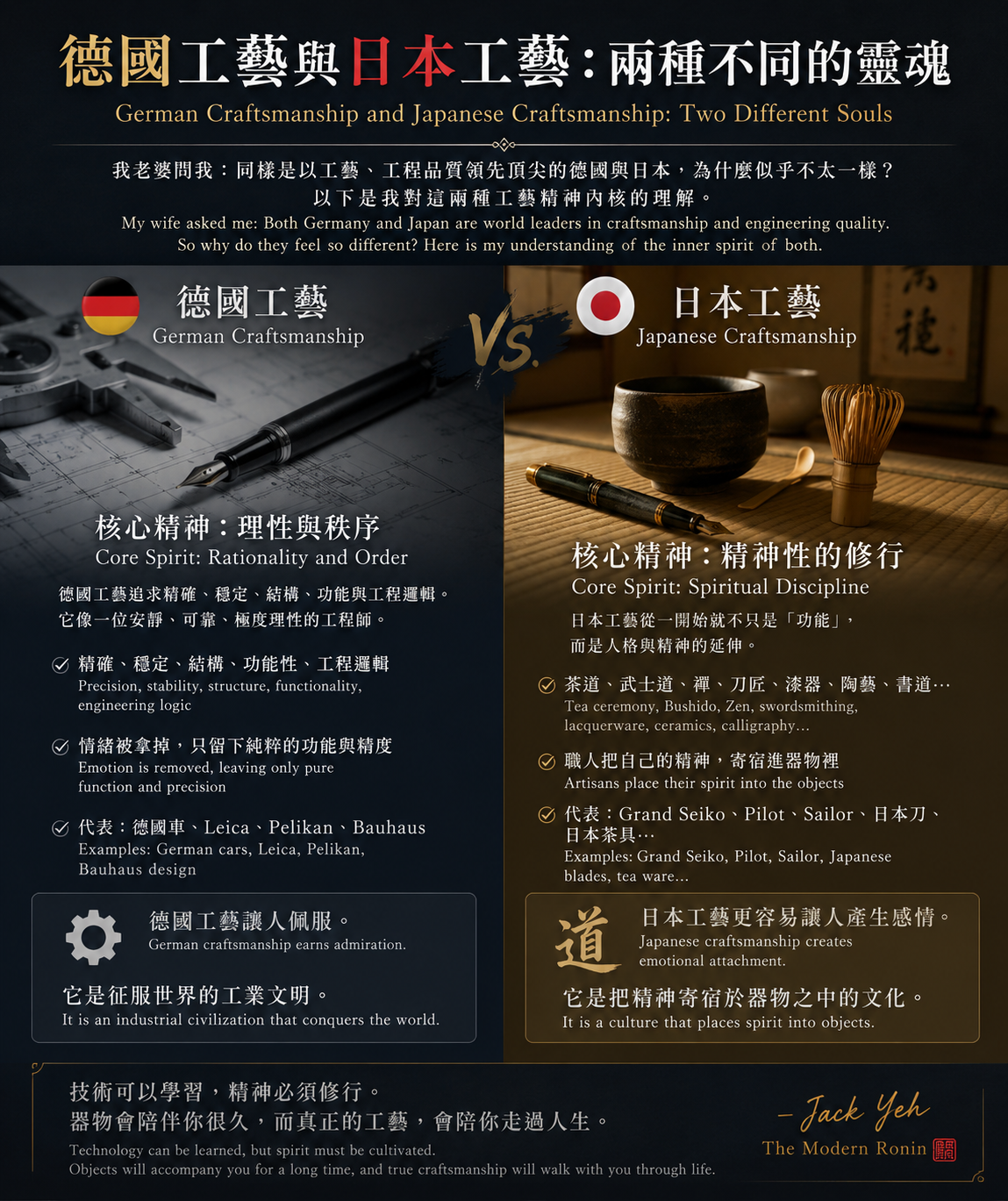
Although both Germany and Japan pursue precision, quality, and technical excellence,
the spirit behind their craftsmanship is fundamentally different.
German craftsmanship feels rooted in:
rationality and order.
It values:
- precision
- stability
- structure
- functionality
- engineering logic
German products often carry a calm and powerful presence.
They feel like the work of a quiet, reliable, highly rational engineer.
German cars, Leica cameras, Pelikan pens, and Bauhaus design all reflect this philosophy.
Emotion is often intentionally removed,
leaving only pure function and precision.
Japan, however, is different.
Japanese craftsmanship feels more like:
a spiritual discipline.
Long before industrialization,
Japan already had:
- tea ceremony
- Bushido
- Zen
- swordsmith traditions
- lacquerware
- ceramics
- calligraphy
So Japanese craftsmanship was never only about function.
It became:
an extension of one’s spirit and character.
Many Japanese artisans are not simply “making products.”
They are placing part of their spirit into the object itself.
That is why many Japanese creations do not feel like industrial products.
They feel like objects with a soul.
Grand Seiko, Pilot, Sailor, Japanese blades, tea ware —
they are not merely designed to impress.
They are designed to accompany a person through life.
German craftsmanship earns admiration.
Japanese craftsmanship often creates emotional attachment.
Germany represents:
an industrial civilization that conquers the world.
Japan represents:
a culture that places spirit into objects.
And perhaps that is why so many people feel deeply connected to Japanese pens, watches, knives, music, and even izakaya culture.
Because within those objects,
there is not only technique —
but also:
time, solitude, discipline, and soul.
《德國工藝與日本工藝:兩種不同的靈魂》
今天我老婆問了我一個很有意思的問題。
她問我:
同樣都是世界頂尖、同樣都以工藝與工程品質聞名的德國與日本,
為什麼給人的感覺卻如此不同?
我後來想了很久。
我發現:
德國與日本,
雖然都追求精密、品質與技術,
但它們背後真正的精神內核,
其實完全不同。
德國工藝的核心,
更像是一種:
理性與秩序。
它追求:
- 精確
- 穩定
- 結構
- 功能性
- 工程邏輯
德國很多產品,
會讓人感受到一種冷靜而強大的力量。
它像一位安靜、可靠、極度理性的工程師。
例如:
德國車、Leica、Pelikan、Bauhaus。
它們很多時候會刻意把情緒拿掉,
只留下最純粹的功能與精度。
而日本不太一樣。
日本工藝的核心,
更像是一種:
精神性的修行。
因為日本在工業化之前,
本來就已經存在:
- 茶道
- 武士道
- 禪
- 刀匠文化
- 漆器
- 陶藝
- 書道
所以日本的工藝,
從一開始就不只是「功能」。
而是:
人格與精神的延伸。
日本很多職人,
並不只是「製作產品」。
他們更像是在:
把自己的精神,寄宿進器物裡。
所以你會發現:
日本很多東西,
不像單純的工業產品。
反而更像:
有靈魂的器物。
例如:
Grand Seiko、Pilot、Sailor、日本刀、日本茶具。
它們不是用來炫耀的。
而是陪伴人,
慢慢走過人生的。
德國工藝讓人佩服。
但日本工藝,
更容易讓人產生感情。
德國像是:
征服世界的工業文明。
而日本則像是:
把精神寄宿於器物之中的文化。
也因此,
我越來越理解,
為什麼有些人會對日本的筆、手錶、刀具、音樂甚至居酒屋文化,
產生那麼深的情感。
因為那些東西裡面,
不只是技術。
還有:
時間、孤獨、修行與靈魂。