The First Principles of Language

Recently, I had an interesting realization.
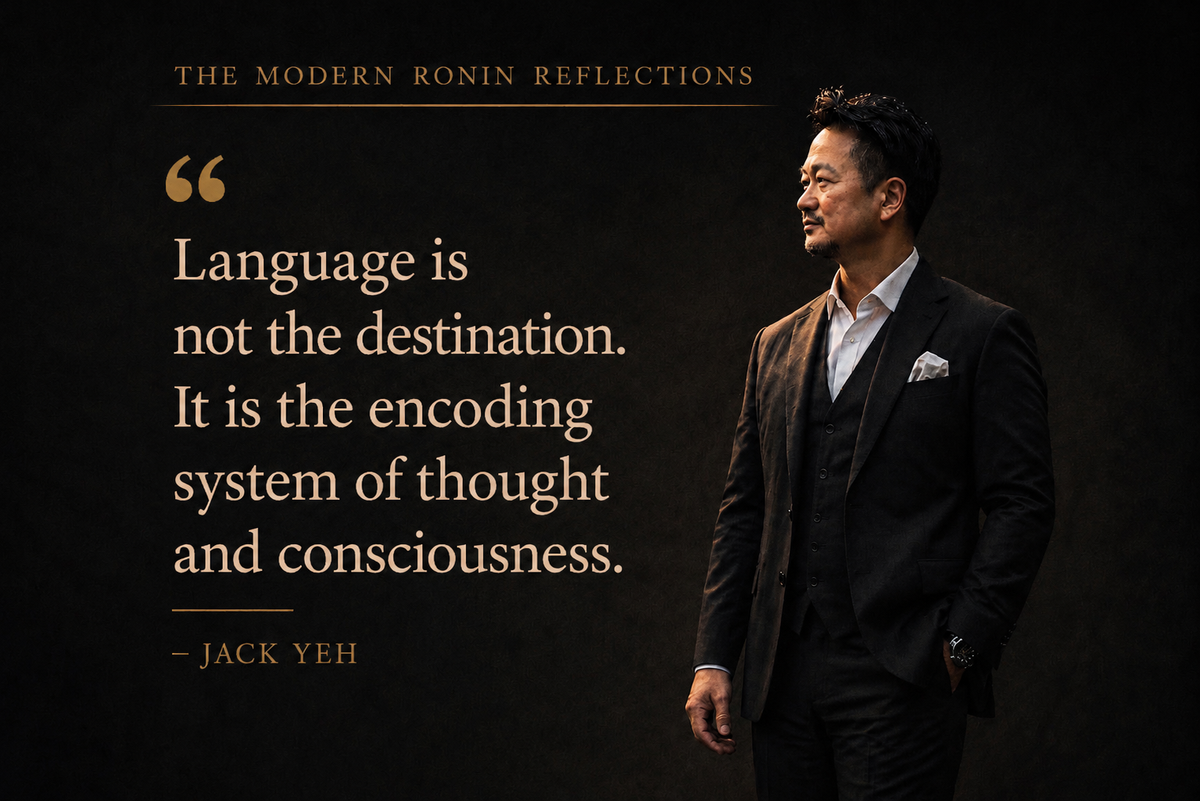
Language is fundamentally an encoding system.
Our thoughts, emotions, experiences, and observations exist within our inner world. The purpose of language is to encode these internal experiences into symbols that others can understand, allowing ideas to be shared and transmitted.
From this perspective, language itself is not the goal.
It is merely a medium.
What truly matters is whether we can use that medium to accurately express what exists within us.
Therefore, language proficiency is not measured by how many words you know or how many languages you speak. It is measured by how much resolution you possess when expressing subtle thoughts, emotions, and observations.
This is one reason why I have chosen to focus on English rather than constantly pursuing additional languages.
Cultural understanding and linguistic ability are not the same thing.
A person may deeply appreciate Japanese culture without speaking Japanese. Likewise, one may understand German ways of thinking without speaking German.
Language is only the encoding system.
For me, the highest return on investment is not learning more systems, but mastering one of the world’s most widely used systems with greater precision.
The greatest writers, thinkers, and communicators all share the same ability:
They can encode experiences that most people can feel but cannot clearly articulate.
That, in my view, is the true power of language.
語言的第一性原理
最近我突然想到一件事。
語言的本質,其實是一套編碼系統。
我們的思想、感受、經驗與觀察,原本都存在於內在世界之中。而語言的作用,就是將這些資訊編碼成別人能夠理解的符號,進而完成分享與交流。
從這個角度來看,語言本身並不是目的。
它只是一種載體。
真正重要的是,我們能否透過這套編碼系統,精準地表達自己內心的想法與感受。
因此,所謂語言能力的高低,並不在於你懂多少單字,或會多少種語言,而在於你是否能夠以足夠高的解析度,表達細微的思想、觀察與情緒。
這也是為什麼我現在專注於學習英文,而不急著學習更多語言。
因為對文化的理解與感受力,並不完全來自語言本身。
一個人即使不會說日文,也可能深刻理解日本文化;即使不會說德文,也可能理解德國人的思維方式。
文化感受力與語言能力並不是同一件事。
而語言,終究只是一套編碼系統。
對我而言,最有效率的方式不是掌握更多語言,而是將一套全球最通用的語言系統掌握到極高的精度。
因為真正卓越的表達者,無論是作家、思想家還是演講者,本質上都在做同一件事:
他們能夠把一般人模糊感受到、卻無法說清楚的東西,用精準的語言編碼出來。
而這,才是語言真正的價值。