The Resolution of Life
One of the things I admire most about Japanese culture is its extraordinary level of resolution.
As an engineer, I often use the word resolution to describe how finely a system can observe and distinguish details.
The higher the resolution, the more information becomes visible.
The world itself does not change.
Our ability to perceive it does.
Take soy sauce as a simple example.
In Taiwan, soy sauce is often just soy sauce.
In Japan, there are countless variations, each designed for different ingredients, regions, and culinary purposes.
What many people consider one thing, the Japanese often see as dozens.
The same pattern appears everywhere:
- Food
- Craftsmanship
- Gardens
- Literature
- Tea
- Architecture
And perhaps most importantly, life itself.
Japanese writers often describe emotions, seasons, silence, loneliness, beauty, and impermanence with remarkable precision.
Not because they experience a different world.
But because they observe the same world at a higher resolution.
Over the past decade, I have gradually realized that personal growth follows a similar path.
When I was younger, I focused primarily on acquiring knowledge and technical skills.
Motor control.
Simulation.
Control theory.
Algorithms.
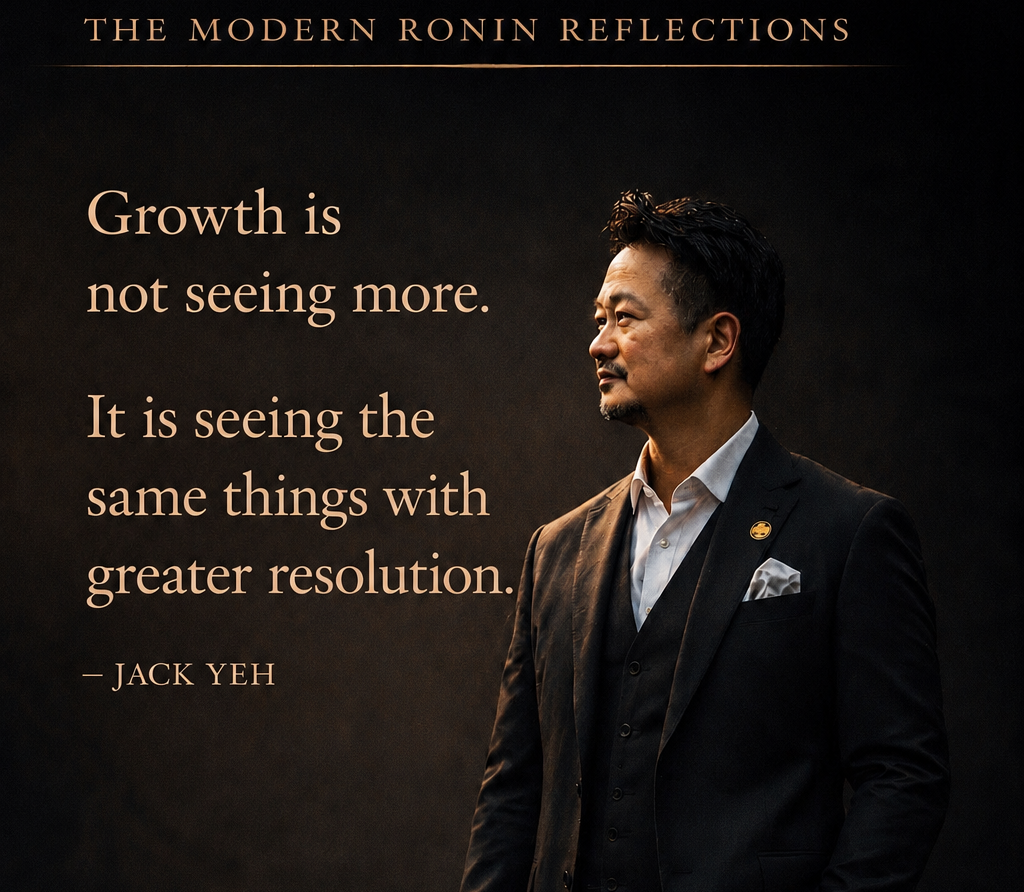
But as the years passed, I discovered that growth is not only about learning more.
It is also about learning to see more clearly.
The same principle applies to learning English, writing books, teaching, self-reflection, and understanding life.
The external world may remain unchanged.
Yet our perception of it becomes increasingly refined.
That is one reason why Vagabond resonated so deeply with me.
What impressed me was not the swordsmanship.
It was the level of observation.
The questions beneath the story.
The subtle understanding of strength, fear, competition, self-awareness, and human nature.
In many ways, I felt that Takehiko Inoue was doing the same thing.
He was increasing the resolution through which we observe life.
And perhaps that is what maturity truly is.
Not accumulating more experiences.
But seeing the same experiences with greater clarity.
生命的解析度
我一直認為,日本文化有一個非常迷人的特質。
那就是它對生活擁有極高的解析度(Resolution)。
身為工程師,我很喜歡用 Resolution 這個詞。
解析度越高,
系統所能看見的細節就越多。
世界本身沒有改變。
改變的是我們觀察世界的能力。
例如醬油。
在台灣,醬油可能就是醬油。
但在日本,同樣是醬油,卻可以細分出數十種甚至上百種不同用途與風味。
許多人眼中的同一件事物,
在日本人的眼中卻可以被看見更多層次。
而這種高解析度的觀察能力,
不只存在於食物之中。
它也存在於:
- 文學
- 庭園
- 建築
- 工藝
- 茶道
- 生活美學
甚至存在於對生命本身的理解之中。
日本作家常常能夠把孤獨、寂寞、季節、美感、無常與人性的細微變化,描述得極為精準。
並不是因為他們活在不同的世界。
而是因為他們用更高的解析度去觀察同一個世界。
而這幾年來,我也逐漸發現,
真正的成長其實也是如此。
年輕的時候,我追求的是更多知識與更多技術。
馬達控制。
控制理論。
模擬技術。
演算法。
但隨著年紀增長,我慢慢發現,
成長並不只是學到更多東西。
更重要的是,
學會看得更清楚。
這個道理同樣適用於:
學習英文、
寫作、
教學、
自我反思、
以及對生命的理解。
外在世界或許沒有改變。
但我們看待世界的解析度卻提高了。
這也是為什麼《浪人劍客》如此讓我產生共鳴。
真正吸引我的不是劍術。
而是它對生命的觀察。
對強大、恐懼、競爭、自我覺察與人性的理解。
在我看來,
井上雄彥所做的事情,
其實也是提高生命的解析度。
而我認為,
這或許就是成熟真正的意義。
不是經歷更多事情。
而是以更高的解析度,
重新看見同樣的人生。