Vagabond: A Journey Into Strength, Life, and the Self
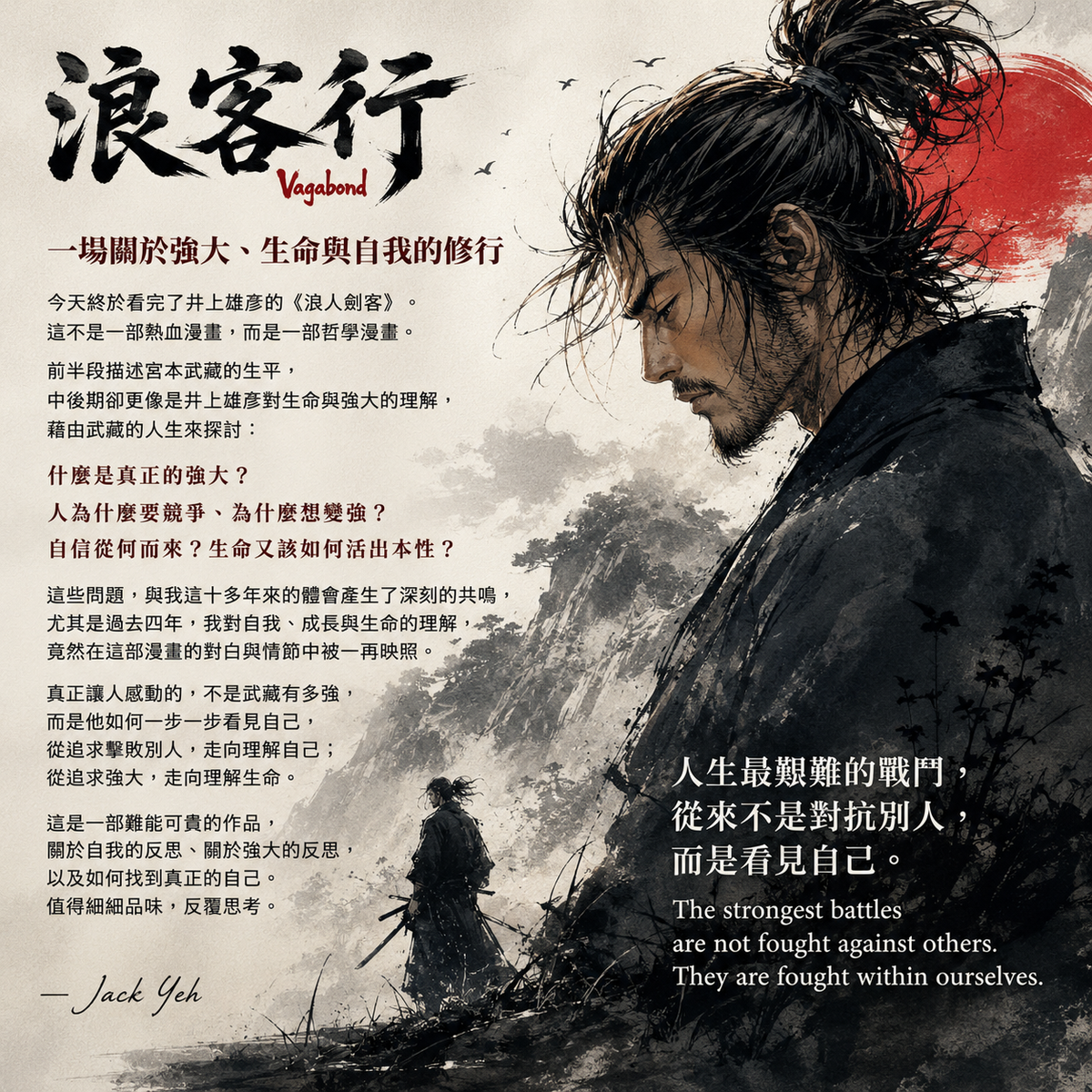
Today, I finally finished reading Takehiko Inoue's Vagabond. Although the series remains unfinished at thirty-seven volumes, it already feels complete in the questions it asks and the insights it offers.
For readers looking for an action-packed manga, Vagabond may not be what they expect.
Its greatest strength is not swordsmanship or duels.
It is philosophy.
The earlier volumes focus on the life and growth of Miyamoto Musashi.
But as the story progresses, it becomes clear that the manga is no longer just about Musashi.
Instead, it becomes a vehicle through which Takehiko Inoue explores deeper questions:
What does it truly mean to be strong?
Why do people seek strength?
Why do we compete?
Where does confidence come from?
And how do we live according to our true nature?
As I continued reading, I felt that Inoue was not really writing about swordsmanship.
He was writing about life itself.
The later chapters, especially those dealing with self-awareness, inner alignment, the flow of life, and the redefinition of strength, resonated deeply with me.
Perhaps that is why this work felt so familiar.
Over the past decade—and especially during the last four years—I have spent considerable time reflecting on growth, learning, teaching, writing, and the search for meaning.
Many of the insights I arrived at through my own experiences seemed to reappear throughout the pages of Vagabond.
What moved me most was not how powerful Musashi became.
It was how he gradually came to see himself more clearly.
How he moved from defeating others to understanding himself.
How he moved from pursuing strength to understanding life.
To me, that is what makes Vagabond such a remarkable work.
It is not simply a story about swordsmanship.
It is a story about self-reflection.
A story about the meaning of strength.
And ultimately, a story about finding oneself.
After finishing the series today, I wanted to write down these reflections as a personal remembrance.
— Jack Yeh
Vagabond:關於強大、生命與自我的一場修行
今天終於看完了井上雄彥的《浪人劍客》(Vagabond)。
全套共三十七集,雖然故事目前仍未完結,但對我而言,這已經是一部相當完整而深刻的作品。
如果你期待的是一部熱血漫畫,或許會有些失望。
因為《浪人劍客》真正吸引人的地方,並不是劍術,也不是決鬥。
它更像是一部哲學漫畫。
前半段的故事,主要圍繞著宮本武藏的成長歷程與傳奇生平。
但到了中後期,我認為作品的重心已經不再只是描述武藏。
它更像是井上雄彥藉由宮本武藏的人生,去探索一些更深層的問題:
什麼是真正的強大?
人為什麼想要變強?
人為什麼要競爭?
自信從何而來?
以及,生命究竟應該如何活出自己的本性?
在閱讀的過程中,我逐漸感受到,井上雄彥真正想探討的並不是劍道。
而是生命本身。
尤其是後期關於自我覺察、內在對齊、生命流動,以及對「強大」重新定義的部分,讓我印象非常深刻。
也許正因為如此,這部作品與我這十多年來的人生歷程產生了許多共鳴。
特別是過去四年,在離開原本的人生軌道之後,透過寫作、教學、創作與反思,我逐漸體會到許多關於自我、成長與生命的理解。
而這些體會,竟然在《浪人劍客》的許多對白與情節之中,再次被映照出來。
真正讓人感動的,不是武藏有多強。
而是他如何一步一步看見自己。
如何從追求擊敗別人,走向理解自己。
如何從追求強大,走向理解生命。
我認為這是一部非常難能可貴的作品。
它不只是關於劍道。
更是關於自我的反思。
關於強大的反思。
以及關於如何找到真正的自己。
今天看完整套漫畫之後,特地寫下這篇心得,作為留念。
— Jack Yeh