When the Outer Battlefield Disappears, Humanity Is Forced to Face the Inner One
After the Battle of Sekigahara, Tokugawa Ieyasu unified Japan, ushering in more than 260 years of peace under the Tokugawa shogunate.
But before that, Japan was in the Sengoku era — a true age of war.
In that world, the role of the samurai was simple:
- to fight,
- to survive,
- to kill,
- and to prove one’s strength.
Strength was everything.
A samurai who was not strong enough could die at any moment.
In essence, the samurai was a machine of war.
However, once Tokugawa unified Japan, large-scale wars disappeared.
The samurai still existed, but the world no longer needed battlefield warriors in the same way.
And so a deeper question emerged:
If the outer battlefield disappears,
what remains of human meaning?
As a result, many samurai began turning inward:
- Zen,
- Bushido,
- self-cultivation,
- discipline,
- and inner refinement.
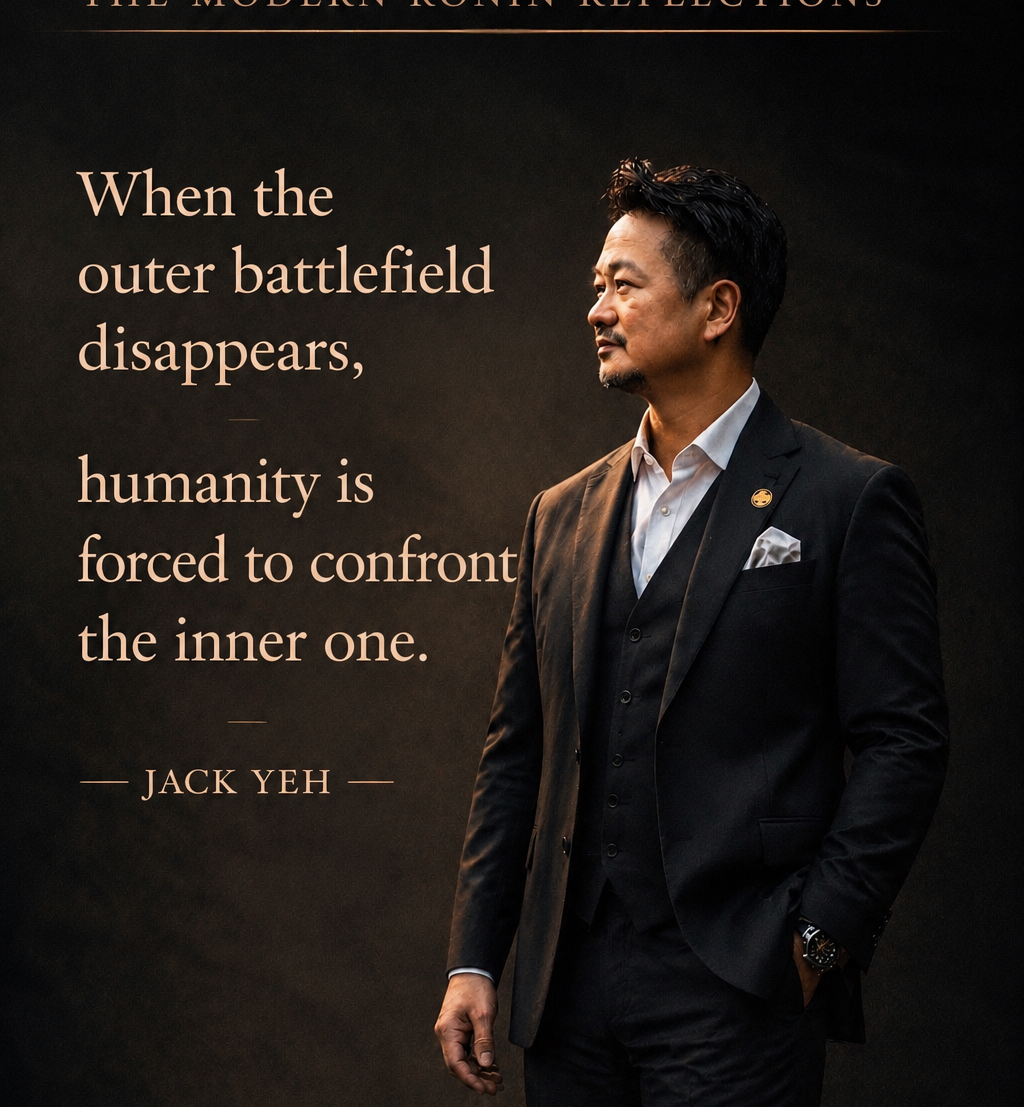
Because when the outer battlefield disappears, humanity is forced to confront the inner one.
I believe the AI era mirrors this historical transition in a profound way.
Before AI, especially among white-collar professionals, people spent their lives:
- learning new skills,
- earning higher degrees,
- collecting titles,
- increasing their utility,
- and proving their value.
Because the modern world was fundamentally a competitive arena of capability.
But with the rise of AI, many forms of white-collar work are becoming replaceable:
- analysis,
- writing,
- coding,
- translation,
- design,
- data processing.
AI can now perform many of these tasks faster, cheaper, and often more efficiently.
As a result, many people are beginning to experience something deeper than job anxiety:
a crisis of existence.
Because the real fear is not merely losing work.
The deeper fear is this:
If AI can perform most of my skills,
then what remains of me?
This is remarkably similar to what the samurai once faced.
After the Sengoku era, samurai were forced to confront the inner self.
In the AI era, white-collar society is now being forced to do the same.
And perhaps this raises one of the defining questions of our time:
What is the human being beyond utility?
Perhaps in the next era, what will become truly rare is no longer skill alone—
but a complete human being.
外部戰場消失之後,人被迫面對內在
關原之戰之後,德川家康統一了日本。
接下來,日本進入了長達兩百六十多年的和平時代。
但在那之前,日本正處於戰國時代。
那是一個真正的亂世。
武士的存在價值非常直接:
- 戰鬥
- 生存
- 殺敵
- 證明自己
在那個時代,「強」就是一切。
每一個武士都必須不斷追求更強,因為不夠強,就可能死亡。
所以武士本質上是一種戰爭機器。
然而,當德川家康完成統一之後,大型戰爭消失了。
武士依然存在,但世界已經不再需要真正的戰場武士。
於是,一個更深層的問題開始浮現:
如果外部戰場消失了,
那麼人存在的意義是什麼?
於是,日本武士階級開始轉向:
- 禪
- 武士道
- 修身
- 自我修煉
- 心性的鍛鍊
因為當外部戰場消失之後,人被迫開始面對自己的內在。
而我認為,AI 時代與這段歷史非常相似。
在 AI 出現之前,尤其是白領階級,幾乎所有人都在做同一件事:
- 學習更多技能
- 取得更高學歷
- 累積更多 title
- 提升自己的工具性
- 證明自己的價值
因為過去的世界,是一個「能力競技場」。
但 AI 出現之後,許多白領工作開始被取代:
- 分析
- 寫作
- 程式
- 翻譯
- 設計
- 資料整理
AI 不只會做,甚至做得更快、更便宜、更有效率。
於是,白領階級第一次開始感受到:
存在感危機。
因為真正令人不安的,不只是工作可能被取代。
而是:
如果 AI 能完成我大部分的技能,
那我到底還剩下什麼?
這其實與當年的武士極其相似。
戰國結束後,武士被迫面對內在。
AI 時代之後,白領也同樣被迫面對內在。
而這個「內在」究竟是什麼?
我認為,這將是下一個時代最重要的問題之一。
也許下一個時代真正稀缺的,
不再只是技能。
而是一個完整的人。